Cleaning a healthcare facility is a completely different job from cleaning any other kind of building. The standards are higher, the consequences of failure are more serious, and the knowledge required to do it correctly is specialized in ways that most commercial cleaning companies simply don’t have. If you’re running a clinic, hospital, or medical office and using a general commercial cleaning service, there’s a real chance the cleaning you’re getting isn’t meeting the standards your patients and your regulators expect.
A professional healthcare cleaning company isn’t just a cleaning company that agreed to clean a medical building. It’s an organization with trained staff, documented healthcare protocols, EPA-registered disinfectants, and the accountability systems to prove the work is being done correctly. That difference matters — a lot.
Why Healthcare Cleaning Is Its Own Discipline
In a standard office, the primary concern is appearance and general hygiene. In a healthcare setting, the stakes are entirely different. Patients in clinics and hospitals are often immunocompromised, recovering from procedures, or dealing with conditions that make them vulnerable to infections they’d otherwise fight off easily.
Healthcare-associated infections — HAIs — are a serious and ongoing public health problem. Thousands of patients contract infections in healthcare settings every year, and inadequate environmental cleaning is a documented contributing factor. Pathogens like MRSA, C. difficile, and VRE can survive on hard surfaces for days or weeks. Eliminating them requires specific products, specific application techniques, and specific dwell times — not just a wipe with whatever’s handy.
A trained healthcare cleaning company understands pathogen biology at a practical level. Their staff knows which surfaces harbor the highest risk, which products are effective against which organisms, and how to clean in a way that actually reduces transmission rather than just making surfaces look clean.
Regulatory Compliance Is Part of the Service
Healthcare facilities operate under a web of regulatory requirements that directly touch on environmental cleaning. OSHA’s bloodborne pathogen standard governs how surfaces potentially contaminated with blood or OPIM are handled. The CDC publishes guidelines on environmental infection control that represent the standard of care. The Joint Commission evaluates infection prevention practices during accreditation surveys.
A professional healthcare cleaning company builds its programs around these requirements. Cleaning logs and documentation are maintained to support compliance audits. Products used are EPA-registered for healthcare use. Staff training covers bloodborne pathogen safety and proper PPE use. When a surveyor comes in and asks to see your environmental cleaning program, you should be able to produce documentation that demonstrates competence, not scramble to explain a gap.
Zone-Based Cleaning for Different Risk Areas
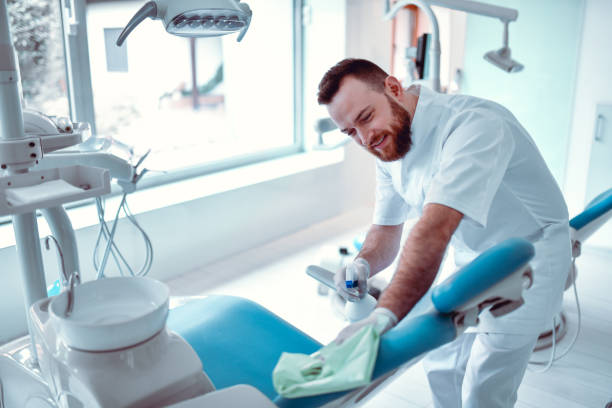
Not every area of a healthcare facility carries the same infection risk, and professional healthcare cleaning programs reflect that. Patient care areas — examination rooms, procedure rooms, and treatment spaces — carry the highest risk and receive the most rigorous cleaning protocols. Terminal cleaning after a patient discharge is a specific process that involves systematically disinfecting every surface in the room before the next patient arrives.
Common areas, waiting rooms, and administrative spaces carry lower clinical risk but still require consistent attention because they’re the spaces that patients, visitors, and staff all move through. Restrooms in healthcare facilities need clinical-grade sanitation given the patient population using them.
A zone-based approach allocates cleaning resources appropriately — higher frequency and more rigorous protocols where the risk is highest, calibrated maintenance in lower-risk areas. This is how professional healthcare cleaning companies operate, and it’s what separates a well-designed program from a generic one.
Staff Training Is Non-Negotiable
The best healthcare cleaning protocols in the world are useless if the people applying them aren’t trained properly. Healthcare cleaning staff need to understand more than how to clean — they need to understand why. Why certain products must be used on certain surfaces. Why dwell time matters and what happens when it’s rushed. Why PPE is required in certain zones. Why you don’t use the same cloth to clean a patient chair and a door handle.
A professional healthcare cleaning company invests in ongoing training, not just one-time orientation. They document training records. They conduct quality inspections. They hold staff accountable to standards that are designed around patient safety, not just operational convenience.
For clinics, hospitals, and medical offices that need a cleaning partner capable of meeting healthcare standards, PBC Cleaning is the healthcare cleaning company built for exactly this work.